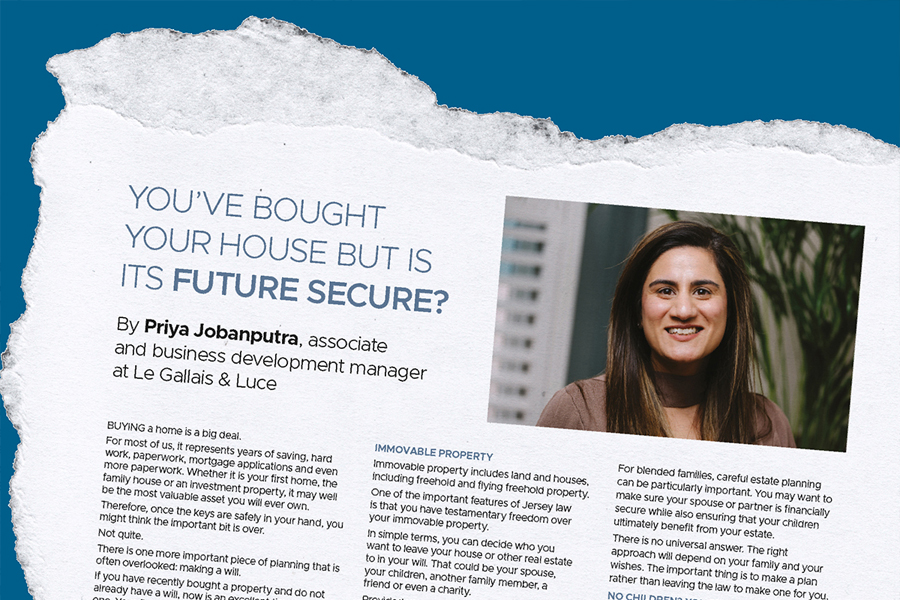
By Priya Jobanputra, associate and business development manager.
BUYING a home is a big deal.
For most of us, it represents years of saving, hard work, paperwork, mortgage applications and even more paperwork. Whether it is your first home, the family house or an investment property, it may well be the most valuable asset you will ever own.
Therefore, once the keys are safely in your hand, you might think the important bit is over.
Not quite.
There is one more important piece of planning that is often overlooked: making a will.
If you have recently bought a property and do not already have a will, now is an excellent time to make
one. Your financial circumstances have changed significantly, and a properly drafted will can help ensure that your property and other assets pass to the people you choose.
Your property may not be inherited as you think
It is easy to assume that if you die without a will, everything will simply pass to the people you love.
Unfortunately, the law does not work quite like that.
If you die without a valid will, your estate is distributed under the rules of intestacy. These rules determine who inherits your assets according to a legal formula.
They do not know that you always intended your partner to have the house. They do not know that you wanted to help a particular child, leave something to a sibling or support a favourite charity.
The law cannot read your mind. A will can.
By making a will, you can set out clearly who you want to benefit from your estate and, importantly, who you want to inherit your property.
You insured the house. Why not protect its future too?
Think about everything you did when buying your property.
You probably arranged a mortgage, instructed a lawyer, carried out searches, signed an impressive pile of documents and arranged insurance.
A will is another form of protection, just one that is designed for the future.
For many people, their home is their biggest financial asset. A properly prepared will can provide certainty
about what should happen to it when they die. It can also make things easier for those left behind by
reducing uncertainty, confusion and the potential for disputes at an already difficult time.
You have spent years working out how to buy the house. It is worth spending a little time deciding what should happen to it afterwards.
Jersey law: not all property is treated the same
This is where things get particularly interesting in Jersey.
Jersey law distinguishes between immovable property and movable property, and the distinction is important when making a will.
Immovable property
Immovable property includes land and houses, including freehold and flying freehold property.
One of the important features of Jersey law is that you have testamentary freedom over your immovable property.
In simple terms, you can decide who you want to leave your house or other real estate to in your will. That could be your spouse, your children, another family member, a friend or even a charity.
Provided your will has been validly executed, you have considerable freedom to decide who should benefit from your immovable property, subject to any right of dower a spouse/ civil partner may have.
Movable property
Movable property is treated differently. This includes savings, investments, shares, personal belongings and other financial assets. It also includes shares in share transfer property.
Your movable estate maybe subject to Jersey rules of légitime. These rules provide the surviving spouse or civil partner and children with statutory rights to a share of the deceased’s net movable assets.
This is why taking proper legal advice when preparing your will is so important. The distinction between movable and immovable property can have a significant impact on how your estate is dealt with, so it is important to make sure your will reflects your wishes and takes account of the law.
Not married? Don’t assume your partner is protected
One of the most common misconceptions is that if you have been together for years, your partner will automatically inherit your property. If you are not married or in a civil partnership, that is generally not the case.
You may have bought your home together, shared the mortgage, paid the bills and built a life together. But without a will, your surviving partner may not automatically inherit your share of the property.
That can create significant financial and emotional difficulties at an already painful time. A will gives you the opportunity to make your wishes clear and put appropriate arrangements in place for your partner.
Blended families need careful planning
Families today come in all shapes and sizes. There may be children from previous relationships, children from a current marriage or partnership, a new spouse or an unmarried partner.
For blended families, careful estate planning can be particularly important. You may want to make sure your spouse or partner is financially secure while also ensuring that your children ultimately benefit from your estate.
There is no universal answer. The right approach will depend on your family and your wishes. The important thing is to make a plan rather than leaving the law to make one for you.
No children? You still need a plan
Not everyone has children. But that does not mean you should leave your estate to chance.
Perhaps you want your property to pass to your partner, siblings, nieces or nephews. Perhaps there is a close friend you would like to benefit. Or maybe there is a charity that means a great deal to you.
Whatever your wishes, a will gives you the opportunity to say so, otherwise, the law gets the final say.
A will is a gift to those you leave behind
It is easy to think of a will as something to deal with later.
There is always a reason to put it off. You are too busy. You are too young. You have not finished sorting out your finances. You will get around to it next year.
But a will is really about making life easier for the people you leave behind.
When someone dies, families are already dealing with grief. Having clear instructions can remove uncertainty and prevent loved ones from having to guess what you would have wanted.
A good will says: “I have thought about this, and I have made the decision for you.”
That can be a very valuable gift.
You’ve bought the house. What’s next?
Buying a property is one of the biggest financial commitments most people will ever make.
Once the champagne has been opened, the boxes unpacked and the first DIY disaster survived, it is worth taking one final practical step.
Make a will
You worked hard to buy your home. Take the same care over deciding what happens to it in the future because while buying the house may have been the hard part, making sure it ends up in the right hands could be just as important. Making a will is a small step for you but it is a meaningful one for someone else.