
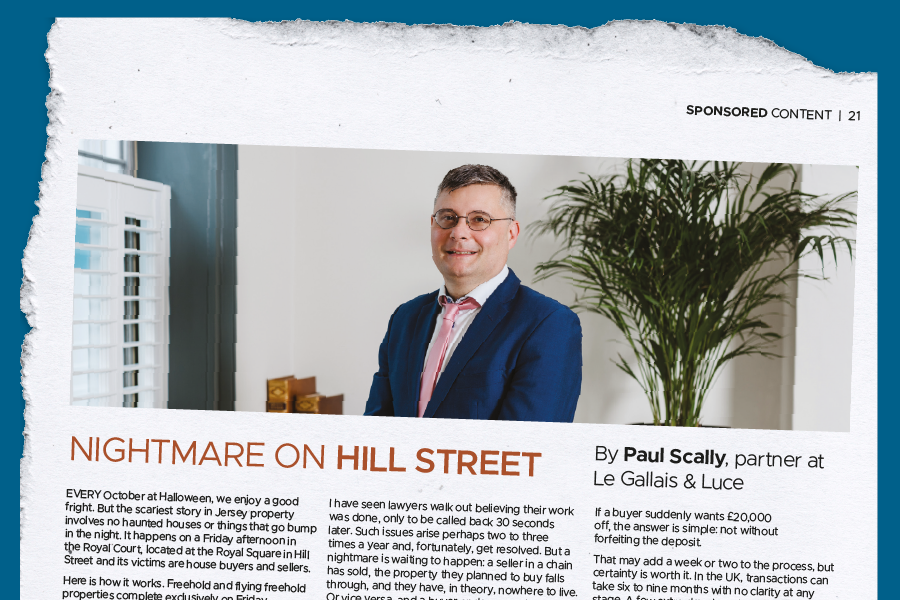
By Paul Scally, Partner, Le Gallais & Luce
Every October at Halloween, we enjoy a good fright. But the scariest story in Jersey property involves no haunted houses or things that go bump in the night. It happens on a Friday afternoon in the Royal Court, located at the Royal Square in Hill Street and its victims are house buyers and sellers.
Here is how it works. Freehold and flying freehold properties complete exclusively on Friday afternoons, when contracts are formally passed before the Royal Court. The buyer and seller, or their appointed attorneys, must be represented in court to swear an oath on the contract. The system has roots stretching back more than 300 years, and it has changed remarkably little since.
Many people assume that once they are inside that courtroom, the deal is done. It isn’t. Until the very last contract is passed, things can still go wrong.
The myths and the real monsters
Let’s start with the myth. People have all heard stories of a last-minute gazump on the court steps, where a stranger offers the vendor £15,000 more and the sale collapses. In my experience it very rarely happens. By that stage, everyone is too far down the road.
The more common spectre is gazundering, where a buyer tries to cut the price in the final 48 hours. Sometimes this is entirely legitimate. A survey may reveal asbestos, a drainage problem that will cost £10,000 to £15,000, or a property sold as having three parking spaces that only has two. Buyers in that position are right to revisit the price. Other buyers are simply chancing their arm, and they rarely get away with it.
The cure, for the most part, is preparation. Sellers should make sure their estate agent’s particulars are absolutely correct, and should disclose any issues up front. Estate agents can only pass on what they are told, and it is the conveyancer or surveyor who finds the skeletons in the cupboard. If your property keeps returning to the market after failed sales, there is nearly always a reason, and it never stays buried for long. Buyers, for their part, need their finance in place before they make an offer, not after.
When the lights go out
The real horror is in the court process itself, and I have seen it first-hand.
I have watched a seller reconsider in court because the house she was buying hadn’t been cleared of the owner’s belongings, after her own buyers had already sold their home. I have seen lawyers walk out believing their work was done, only to be called back 30 seconds later. Such issues arise perhaps two to three times a year and, fortunately, get resolved. But a nightmare is waiting to happen: a seller in a chain has sold, the property they planned to buy falls through, and they have, in theory, nowhere to live. Or vice versa, and a buyer ends up owning two properties It has happened and has only been sorted by the quick actions of those involved and the kindness of the judge sitting.
There is no closing time and no safety net. The court sits, works through the list and finishes when the contracts are done. If you are stuck in traffic, delayed at the office or simply late, you have missed your slot, and nothing says you can go back. I once had a swap of two houses where a young lawyer walked out early. We only completed because the court official that day was kind enough to let us. It should not depend on kindness.
Not every problem is human error, and not every rescue can be improvised. Imagine owning two properties, or none, because a transaction failed in a courtroom with no route to put it right. That is the true Nightmare on Hill Street: a Jersey buyer who has sold but cannot buy, or a seller who has bought but cannot sell.
The toll on the people involved
I want to say something about the people in the room. Conveyancers work under intense pressure every Friday. I have seen colleagues shaken by a mistake in court that was not their fault. Not enough new conveyancers are coming into the industry to replace the ones who are leaving or have retired. The system depends on individuals never having a bad day, and that is not a safe way to run one of the biggest financial decisions of anyone’s life.
A better ending
The good news is that this horror story can be rewritten. I would suggest three changes.
- Bind the deal earlier. Everyone involved should agree a date. Title checks, site visits, documents, insurance and funds are all lined up. On that date, a binding pre-sale agreement is signed, with a non-refundable deposit, perhaps £5,000 to £10,000. Completion follows on the next available court Friday, or the one after. That gives people a week to book removals and time off work, and gives everyone a reason to stay committed. If a buyer suddenly wants £20,000 off, the answer is simple: not without forfeiting the deposit.
That may add a week or two to the process, but certainty is worth it. In the UK, transactions can take six to nine months with no clarity at any stage. A few extra days here buys a great deal of peace of mind. Deputy Max Andrews has been vocal on the need for pre-sale agreements, and I agree with the principle. The detail must be right, and it will need proper legislation from the States Assembly and a standardised document used. The Royal Court enforces the law, but the States write it. We must also consider who is to bear the cost of the pre-sale agreement. - Tighten what happens before an offer is accepted. Vendors should carry a clearer obligation to disclose issues and to check their agent’s details. Buyers should be able to show a mortgage agreement in principle and evidence of their deposit when they make an offer. That would deter time-wasters, including those who put offers on a house with no knowledge of whether they can get a mortgage for the amount they are offering, while sellers and chains organise their lives around them.
- Give the court a back-up plan. Why not allow the Judicial Greffier to administer the oath, in front of two witnesses, up to 5pm on a Friday? If the funds aren’t quite there at 2:30pm, or someone is delayed, there would be a way to complete rather than being sent home empty-handed. It is a small change, and it would remove much of the terror from the afternoon.
Happily ever after
Completion day should feel like a wedding. By the time you walk up the aisle, the caterers, the photographer and the ring should all be sorted, and you shouldn’t be wondering whether your partner-to-be will turn up. Buyers and sellers should stroll to court, raise a hand and pick up the keys.
Jersey’s property system has served us for centuries. But the world has changed, and every other area of law has modernised. Property shouldn’t be the exception, still relying on an unwritten hope that nothing goes wrong on a Friday afternoon.
Let’s end this story before something truly frightening happens. Then the only tricks and treats at Halloween will be the ones at your front door.